But while some brands turn this into a conscious strategy, others leave it to chance. Yet building a brand is about creating a character. If this company were a person, what kind of person would it be? What values would it stand for? What would it say, and how would it act?
And these are exactly the questions we start with.
But while some brands turn this into a conscious strategy, others leave it to chance. Yet building a brand is about creating a character. If this company were a person, what kind of person would it be? What values would it stand for? What would it say, and how would it act?
And these are exactly the questions we start with.
When building brand communication, we first lay down a solid strategic foundation. The elements of that foundation are:
Brand Positioning Studies
Brand Key
Competitor Analyses
Target Audience &
Segmentation Models
Brand Essence
Think of your brand as a person. We define its core and secondary traits. In what ways does it resemble its competitors, and in what ways does it stand apart? What are its roots the principles that never change? By answering these questions, we build a character.
When this character steps into the field, it knows not only its audience, but also their behaviors, decision making processes, and moments of need. For every target circle, it has a distinct tone and attitude. It enters through the door with its own words and stance. It expresses itself through its brand character positioning itself among competitors and creating real differentiation.
And when it leaves the room, what remains is the brand essence. In other words: even when you’re not there, whatever you want people to say about you that’s what we plan.

Why does your brand exist? What gap does it fill? What does it bring to society, to the industry, to the customer?
By answering these very questions, we turn your brand into more than just a business we give it meaning. This way, we strengthen your hand in marketing and secure a sustainable edge in competition.
In this process, we work with research firms when needed analyzing data and generating insights. Because in theory, everything can look perfect; but ideas that don’t match market reality are nothing but a waste of time.
Because everyone in your company spends a significant part of their life working for this structure. That effort must have meaning, it must be told right, and it must create a shared language. What you need isn’t coincidence it’s strategy. A structure where everyone speaks the same language and rallies around the same purpose is what carries you to success.
Most of the time, you work with agencies. But without a defined brand communication inside the company, agencies act on their own interpretation. The result? Creative ideas that drift away from your vision and outcomes that fail.
Or you build new partnerships. But if there’s no shared vision, the process is reduced to money. It becomes a short term chase for profit, not a sustainable relationship. Over time, that’s exhausting and unproductive.
Just as you carefully instill values in a child’s development, you need to show the same care to the brand that gives you this life. Because our work isn’t separate from our lives it’s the most visible reflection of them.
Strategy is the conscious choice of a company’s place in the market. Yet most of the time, without realizing it, we try to grow our brand but only end up “fattening” it. And that bulk doesn’t just limit agility it blocks the path to true professionalism.
Brand strategy isn’t just about growth; it’s about building a structure that is right, flexible, and sustainable. Especially in markets like Turkey, where economic fluctuations are frequent, we all see how exposed brands without a strategy truly are. Let’s not forget: we spend our lives working for these brands. That’s why strategy is not just an obligation it’s a responsibility.
Strategy is the conscious choice of a company’s place in the market. Yet most of the time, without realizing it, we try to grow our brand but only end up “fattening” it. And that bulk doesn’t just limit agility it blocks the path to true professionalism.
Brand strategy isn’t just about growth; it’s about building a structure that is right, flexible, and sustainable. Especially in markets like Turkey, where economic fluctuations are frequent, we all see how exposed brands without a strategy truly are. Let’s not forget: we spend our lives working for these brands. That’s why strategy is not just an obligation it’s a responsibility.
You can’t build strategy without analyzing the market. That’s why there are dozens of models borrowed from the academic world:
But we know this: for executives, what truly matters is not the models themselves but how this knowledge is translated into the company and reflected to its people.
At this point: the Strategy House and the OGSM Model (Objectives, Goals, Strategies, Measures) This is where such frameworks come into play. You need to take these strategies off the desk and plan how to integrate them into the company into the daily life of your teams.
Strategy only matters where there is competition. That’s why:
Yes, most companies roll their eyes at this stage. Because SWOT has long been treated as a “fill in the boxes and move on” exercise. But the non-negotiable of a proper SWOT is: Pairing it with the TOWS Model.
In other words: how do strengths combine with opportunities to turn into action? And when weaknesses collide with threats, what risks do they create?
Here, turning insights into operational statements is what gives birth to strategy.
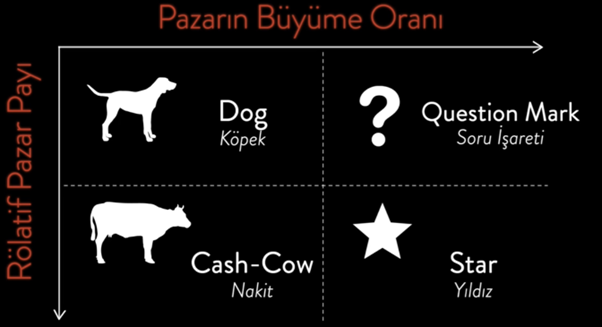
Not every product carries the same value in every time frame, under every market condition. That’s why:
With the BCG Matrix, we classify your products as “Stars, Question Marks, Cash Cows, and Dogs.”
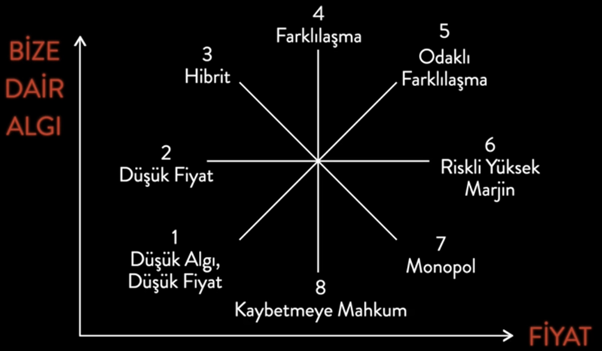
Then, with Bowman’s Strategic Clock Model, we analyze your product’s price–value position in the market.
These two models become your compass for product focused growth plans.
Brand strategy isn’t built for today it’s built for tomorrow. A planned structure protects you from economic swings, sudden crises, and loss of focus. A brand without strategy is like a ship without direction. It may end up somewhere, but not where it was meant to be. At CodeAd, we don’t just design strategy; we make it lived, embraced, and actionable.
Don’t let the names of the methods intimidate you. Our goal isn’t conceptual memorization it’s strategic awareness.
That’s why we enter the stage of strategy with fundamental positions such as Cost Leadership, Cost Focus, Differentiation, and Focus.
And then, a classic strategic tactic comes into play:
“Divide, Fragment, Control.”
When building strategy inside the company, we sometimes forget our own power. But here’s the truth we need to face:
Real power is the marketing budget you hold.
Yes, we all believe we can come up with “better ideas.” And that’s great. But business isn’t about ideas it’s about the power to make them happen.
Just like war… strategy is a battle. The more soldiers you have, the more equipment you hold the stronger you become.
In the world of marketing, your army size = your budget.
For brands that want to dominate the market. It takes courage and investment.
And then we face two seas:
the Blue Ocean and the Red (Bloody) Ocean.
One is about creating brand new opportunities where there is no competition; the other is about trying to survive in spaces where everyone tears each other apart.
Now it’s about embedding the strategy within the company. It has to. Because if a strategy only lives in PowerPoint slides, it was never really made.
This is where the Strategy House comes in.
Example: A Toothpaste Brand
Let’s say a new toothpaste brand enters the market. Its goal:
To gain a 15% market share in Turkey within 10 years.
After analyzing the market, it sees intense competition and chooses a niche: children.
Because the brand knows that loyalty built in childhood continues into adulthood. But it doesn’t stop at defining the target audience it sharpens its strategic statement:
“To become the favorite toothpaste brand of children by making brushing teeth fun.”
This is strategy.
Clear. Understandable. Inspiring.
And simple enough for every unit of the company to understand.
Here’s where the technical part begins. Company goals are aligned with marketing goals.
Because if someone has never heard of you, they can’t buy from you. A marketer’s first goal must always be brand awareness.
This is where we move from marketing to product development. Because strong strategies only gain meaning with strong products.
This process is also the critical point where we craft the Unique Selling Proposition (USP).
Finally, the plan is made for how the product will reach the customer.
Here, we focus on the following:
Strategy finds meaning not in thought alone, but in action.
Strategy is a living system. It is measured, tracked, and rewritten when needed.
We don’t see strategy as just a roadmap.
For us, strategy is your brand’s identity, its stance, and the meaning it carries into tomorrow.
When we say “technology,” we’re not just talking about devices or software. For us, technology means the systems that boost efficiency inside the company and the measurable tools used in marketing.
It doesn’t just make things easier it generates the data that drives strategic decisions.
When we say “technology,” we’re not just talking about devices or software. For us, technology means the systems that boost efficiency inside the company and the measurable tools used in marketing.
It doesn’t just make things easier it generates the data that drives strategic decisions.
One of the most critical of these technologies is our website.
Websites once existed just to “be on the internet.” Today, they’ve become full-scale online workplaces.
A brand’s first impression is usually formed through its website.
When we hear about a business for the first time, we all do the same thing:
We Google it and check the website.
Your website is where potential customers judge you first. And first judgments don’t change easily.
At the same time:
It’s the main hub where cookie data on customer behavior flows directly.
If you want to be visible in search engines:
If you want to convert traffic
If you want to get the highest return from advertising
If you want to sustain the relationship:
If you want to spend the budget wisely
They’re like different floors of the same building all working under one roof. In other words, technologies don’t separate, they integrate.
For some companies, SEO holds a 15% priority. For others, that ratio shifts toward CRM. But in the end, they all serve the same goal: marketing success.
Expecting sustainable success by focusing only on social media is like fixing the shop window without ever looking inside the store.
That’s why, like every branch of marketing, the technology side must be seen as a whole.
We know that after your meetings, people look you up online.
Your website is the digital counterpart of your presentation.
The clearer and stronger the impression you create, the more professional you look.
When you plan all your marketing channels to serve the same story, that’s when strategy and technology unite.